


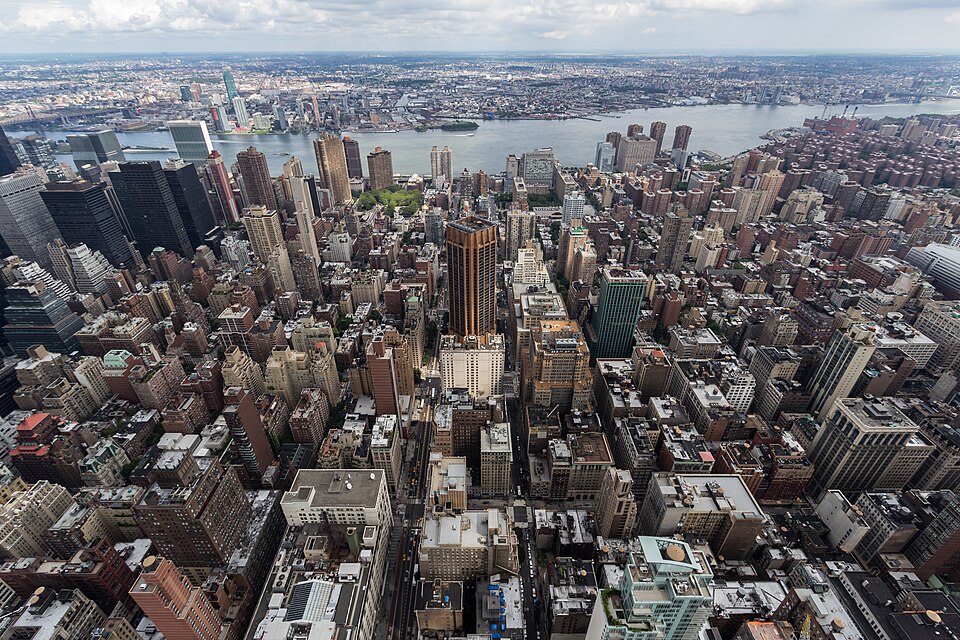

When it comes to backup power, there’s no room for failure. But in urban environments, there’s often even less room for the equipment.
As hospitals, residential buildings, public facilities, and other urban infrastructure increasingly rely on generators and microgrids, the cooling systems supporting those generators are facing a unique challenge: getting into, and out of, tight spaces.
That’s where MESABI® radiators are making all the difference.

David Sullender, Eastern US and Eastern Canada Representative at L&M Radiator, has seen firsthand how difficult conventional radiator replacement and installation can be when a genset is located inside a building, on a rooftop, or in a confined mechanical room.
Take one customer in San Francisco, for example, where a genset serving a condominium’s common areas sits inside a concrete room in a parking garage. Replacing a non-MESABI® radiator in this situation would require a lift costing approximately $50,000 just to move the cooler in and out.
“When I heard that the customer was planning to use a crane to lift this radiator into the parking garage, I was floored,” said Sullender. “I told them that, with a MESABI®, we can build it on site. We fly it out there, and build it right inside the building, right on the genset. It makes a world of difference.”
MESABI®’s Singular Build-On-Site Capabilities
It’s all possible because of the MESABI® tube-and-seal design. Rather than trying to maneuver a large, fully assembled radiator through a building, individual components can be brought into a confined space and assembled where the radiator is needed.
It’s a solution that is proving valuable in increasingly complex urban applications, where spaces are tight.
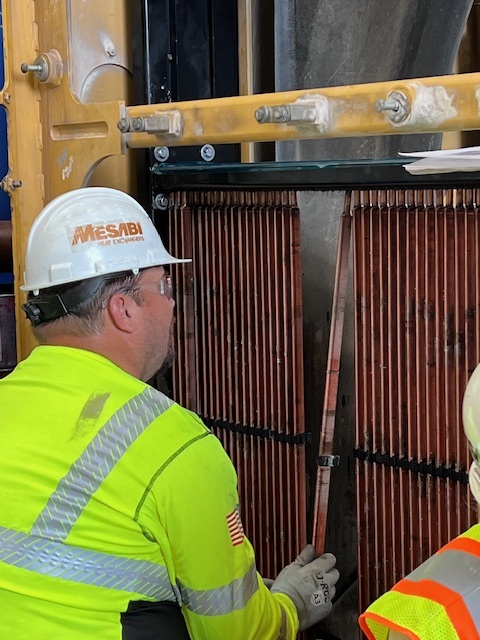
At Vanderbilt University Medical Center in Nashville, Tennessee, for example, the backup genset lives in the very middle of the building. Its radiator is due for a replacement, and, in a hospital setting, you can’t take any chances on having reliable backup power. The lives of patients and the safety of medical professionals depend on it.
The customer was at an absolute loss as to how to replace the radiator. Until, that is, they reached out to Sullender.
“Because we can build the MESABI on site, we can carry radiator components past patient rooms to reach equipment located in the middle of the building,” said Sullender. “If it weren’t for this solution, I don’t know what they would’ve done.”
Relying on Reliability
Another customer is in bustling New York City, where L&M is installing a cooling system on the roof of a building on Wall Street.
As one can imagine, obtaining a permit to erect a crane that would block traffic for hours on one of the busiest streets in the country is difficult. The customer was stuck, until they realized they could cut the crane out of the equation altogether.
“All we have to do is carry the components up to the roof and assemble the radiator there,” said Sullender.
Accessibility isn’t the only challenge. Reliability is critical when a generator may sit idle for months or years before being called into service. And when it comes to reliability, there’s nothing better out there than a MESABI. With a reputation built in the most grueling applications on the planet, urban power generation is a walk in the park.
“If you’re in need for your genset to kick on, and you have your main power down, you want to have the confidence that when it fires up, you don’t have a leak,” said Sullender. “Because of our shock-resistant design, which includes rubber seals to absorb shock and vibration, the MESABI® can stand up against almost anything.”
That confidence matters when a generator is responsible for more than keeping the lights on. In a residential building, a failed genset could mean losing elevators, air conditioning and security lighting. In a hospital or other critical facility, the consequences can be even greater.
Power Generation for the AI Generation
The continued expansion of data centers, increasing demand for electricity and the need for microgrids are driving more investment in distributed and backup power generation. Sullender sees the trend as a major opportunity for MESABI®.
“With AI and these new data centers opening all over the place, more gensets are being required for power,” said Sullender. “Then you get the whole microgrid systems for municipalities being required.”
As power generation moves into more locations where space, access, noise and reliability are all critical considerations, cooling systems will have to adapt.
For L&M Radiator, that means solving cooling challenges wherever the equipment needs to go.
“We’re really just getting started in this market,” said Sullender. “We’re on the cusp of something that can be just huge. We’re poised to make a significant difference for these customers and applications.”
L&M Radiator: There Can Only Be One MESABI
Interested in learning more about the MESABI Radiator in power generation applications? Visit our sales reps page to find the right sales representative for your region.
To read more articles similar to this one, visit the blog on www.mesabi.com, and follow L&M Radiator on LinkedIn, Facebook, and Instagram.